
Hunting the Bitcoin Bottom
Often overlooked, yet an extremely accurate signal, the Bitcoin Long-Term Holder (LTH) supply is a key on-chain metric to watch.
Read Time: 10 Minutes

Pixabay: WorldSpectrum
Key Points
Bitcoin has generally followed a 4-year price action cycle, but is that cycle becoming longer or shorter with institutional participation? If the peak was muted, will bottoms become muted or extended?
The Bitcoin Long-Term Holder Supply metric shows what smarter long-term investors are actually doing.
If Bitcoin becomes a risk-off asset like gold, it may still fail to perform well in recessions, just like gold has often failed. In actual recessions, anything that can be sold for dollars will be sold.
Time-Based Cyclical Nature of Bitcoin
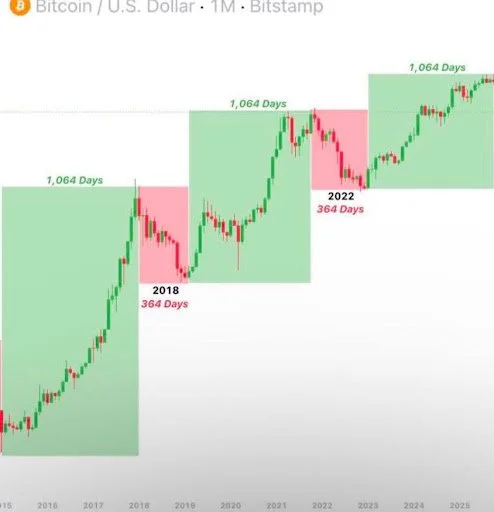
Surprise, surprise… throughout 2026, Bitcoin largely continued to follow a 4-year cycle price action pattern. While it has been a fairly predictable cycle of "rinse and repeat" on longer time scales, with plenty of short-term divergences, overall the echoing price pattern has remained intact.
However, a major question still looms: Is this predictable cyclical nature changing with the arrival of sophisticated institutional investors, or are we just experiencing history repeating itself with minor nuances? Let’s dive in.
"This time is different" is a dangerous phrase that has cost investors a massive amount of money from October 2025 until now. At that time, the majority of the market anticipated a "Super Cycle" that would break Bitcoin's traditional four-year rhythm (three years bull, one year bear) and propel the asset into the $220,000 to $250,000 range.
2025 Bitcoin Mania
Prominent figures like Raoul Pal loudly predicted that Bitcoin would track the M2 money supply, overlaying charts to show the Bitcoin price soaring to $250,000 as it entered the explosive "Banana Zone." Meanwhile, Cathie Wood projected a $1.5 million target by 2030, and Michael Saylor was purchasing billions in Bitcoin every week, before later pausing the massive purchases in 2026. Euphoria was at an all-time high, and leverage was piling up.
But Bitcoin didn't seem to care about enthusiasm or how experts felt. Instead, it still did exactly what it has always done: it followed its strict historical timeline of roughly 1,064 days of a bull market followed by a 365-day bear market.
Today, while recent rallies are printing green candles, we sit at day 350 from the October 6th 2025, all-time high. Is this latest action to the upside just a new, larger counter-trend rally? Or are we really out of the bear market a bit early this time around?
Bitcoin Bear/Bull Theories
Unlike past cycles, so far this cycle Bitcoin has managed to avoid its typical 70% to 80% bear market plunge. Instead, the asset bottomed out with a milder 55% correction, touching lows around $58,000. Following a recent rally, Bitcoin is currently trading over $85,000, still representing a 32% pullback from its 2025 peak of $126,000. With only 15 days remaining in this historically timed bear market, the month of September is shaping up to be a blockbuster period to watch
Bearish camps are holding out for a time-based capitulation, but they are quickly running out of time. Keeping historical cycles in mind, the remaining window for this bear market has shrunk to just a few weeks. For bears to force a new cycle bottom below $58,000, Bitcoin would need a massive downturn requiring an additional 32% drop from current price levels. Given the volatile nature of this asset, such a swift collapse is entirely possible, but the clock is ticking loudly against the bears.
Debasement Trade Tailwinds
Conversely, the bulls are banking heavily on the global currency debasement trade. With the US dollar steadily losing purchasing power and the M2 money supply expanding, sovereigns seeking risk-off, immutable neutral assets like gold, and now possibly Bitcoin, the prevailing bullish thesis is that Bitcoin will inevitably play catch-up.
An equally compelling theory is that Bitcoin completely skipped the typical euphoric blow-off top this cycle. For context, the peak-to-peak return from the 2017 high to the 2021 high was a massive 3.5x multiplier. In stark contrast, the rally from the 2021 peak to the 2025 top failed to even achieve a 2x return. This lack of overextension provides a strong structural argument for the market because Bitcoin didn't experience a violent vertical rip; perhaps it doesn't require a violent vertical crash.
A New Class of Bitcoin Holders
Another critical factor taming Bitcoin’s historic volatility is the steady influx of institutional capital and its so-called "diamond hands" holding strategy. Unlike previous cycles, which were driven by retail investors and lacked major regulated investment vehicles, this cycle features massive spot ETF inflows alongside corporate treasuries adding Bitcoin to their balance sheets.
This institutional backing has structurally altered the market. By injecting deep long-term liquidity, these sophisticated players have been effectively dampening the violent, low-liquidity swings that characterized earlier, retail-driven cycles.
Bitcoin Signal - Long-term Holder (LTH)
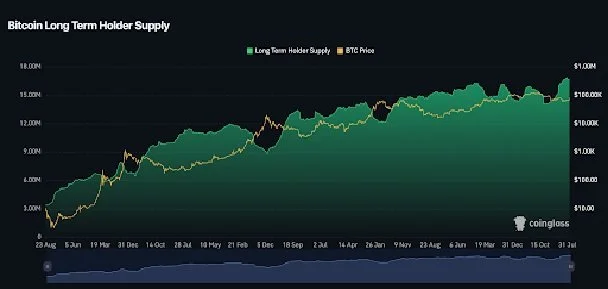
Ultimately, the single most critical factor driving Bitcoin’s current price action is the Long-Term Holder (LTH) supply. These high-conviction investors now control roughly 80% of the circulating supply, effectively dictating the market's broader narrative through both their action, and also their inaction.
The structural shift over the last decade is staggering: in March 2014, the LTH supply sat at a mere 6.5 million BTC; today, it commands an impressive 16 million BTC. Keep in mind the maximum supply of Bitcoin is only 21 million, which means long-term investors control 76% of the total supply. This also represents a massive 170% increase in the illiquid portion since 2014.
Furthermore, since 2023, LTH accumulation has maintained a steady upward trajectory, completely lacking the aggressive, cyclical distribution dips that triggered sharp crashes in previous cycles. Let’s take a closer look at the data
Long-term Bitcoin Cycles
A closer look at historical data reveals a clear, inverse relationship: whenever Long-Term Holder (LTH) supply initially contracts, Bitcoin also undergoes a massive parabolic rally. This phenomenon marks the classic transition where high-conviction hands distribute coins to incoming retail demand during market peaks. Essentially, long-term holders sell their Bitcoin near the peaks, while short-term holders buy near the peaks:
2017 Cycle: In November 2016, LTH supply peaked at 12 million BTC with Bitcoin trading at just $735. By December 2017, that supply had shrunk to 8.8 million BTC as coins changed hands, fueling a massive 26x explosion to $20,000.
2021 Cycle: A similar pattern emerged in October 2020. LTH supply topped out at 14 million BTC while Bitcoin sat at $11,300. By April 2021, LTH supply dropped to 12 million BTC, triggering a 5.3x rally to $60,000.
Changes in LTH Bitcoin Behavior
During the current cycle, Long-Term Holder (LTH) supply has behaved much more stair-step-like. Instead of a massive, one-time distribution, we have witnessed three distinct, minor supply drawdowns of roughly 10%. Yet, despite their smaller scale, each blip maintained the same inverse relationship with price seen in previous cycles:
December 2023: LTH supply hit a then-all-time high of 16.28 million BTC with Bitcoin trading at $43,000. A subsequent supply drop to 14.2 million BTC propelled Bitcoin north of $70,000.
The Re-Accumulation Pullback: LTH supply quickly climbed back to 16.2 million BTC, absorbing liquidity and dragging Bitcoin down from $70,000 to $57,000.
February 2025: LTH supply contracted again to 14.3 million BTC, fueling a powerful rally that sent Bitcoin flying to $96,000.
Q3 2026 Peak to Present: LTH supply surged to a staggering all-time high of 16.8 million BTC, commanding an unprecedented 85% of the total circulating supply (excluding Satoshi's estimated 1 million lost coins) while Bitcoin consolidated around $63,000. Currently, this supply is contracting once more, and true to historical form, Bitcoin’s price has responded by surging to $85,000.
Playbook for Long-term Investors
The cyclical playbook remains straightforward: long-term holders accumulate during market depressions and distribute during phases of macro euphoria. Given that these high-conviction investors have been aggressively stacking for over a year, a new distribution phase could be just around the corner.
Is Bitcoin Becoming Risk-Off?
The ultimate wildcard still remains the broader macroeconomic backdrop. If the US economy slips into a hard landing, it will mark the first true economic recession in Bitcoin's history. Because Bitcoin was born out of the 2008 financial crisis, it has only ever existed inside a macro regime of tech expansion, low interest rates, and central bank liquidity injections.
COVID caused a market shock, but in many ways doesn't qualify as a sustained recession. How this young asset behaves during a prolonged, systemic economic contraction is anyone’s guess, making risk management more critical now than ever before.
The question remains: if wars, rising interest rates, and massive consumer debt spiral into a global recession, will Bitcoin be seen as a safe-haven neutral asset during its first major recession? Will it be treated as risk-off by large investors, similar to gold? Or will it be seen as still more risk-on, and not as an effective hedge against turmoil? Early signs this month suggest the market is testing if Bitcoin can be used as a risk-off play. While major currencies like the Dollar are being debased and inflation still rises, Bitcoin is currently seeing a sustained rally.
Pale Horse - Gold During Recessions
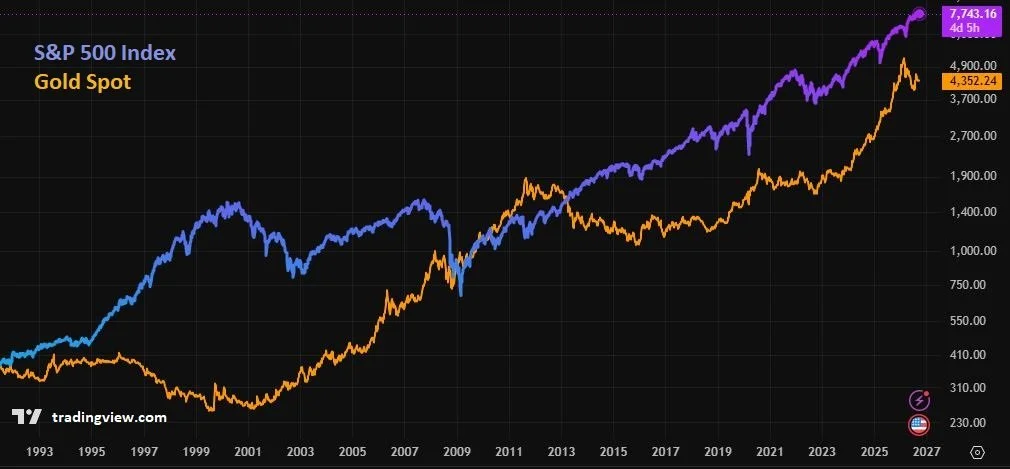
Gold has often been used as a safe-haven asset, as a hedge against global turmoil. In fact, many investors assume if the economy does badly, gold will do well during the same time frame. But what history largely teaches us is that although gold often spikes prior to recessions, and then is generally one of the first assets to make a major comeback during recession bottoming, recessions actually drive retail and long-term investors into cash, even when their currencies are being debased.
Recessions cause a loss of liquidity, and the scramble for more liquidity sucks capital out of not just obvious risk-on assets like stocks, but ultimately sucks capital away from anything that can be sold for dollars, including hard assets. Gold usually regains public confidence faster than equities, but it still suffers the fear-induced sell-offs for cash.
The 2008 financial crisis is a prime example: gold was an early asset to lose value, and then was an early asset to begin a recovery. Although it didn't fall as deeply as stocks, it certainly struggled to be a true hedge during the initial drawdowns.
If Bitcoin fills a similar profile as gold, yes, sovereigns could currently choose to accumulate it along with precious metals, but it may ultimately behave poorly as a hedge against major and early downturns. If the global economy were to experience significant pullbacks, say in 2027 or in the following years, Bitcoin could do the opposite of extending the 4-year cycle into longer bull runs, and instead could print lower lows into a deeper bear in 2027, or cut short a new bull cycle sometime after that.
Special thanks to Zane McMinn, principal at Rothguard, for key insights and research.
Takeaways
1. For the Short-Term Trader: Taking tactical profits into strength is highly prudent as LTH distribution begins to accelerate.
2. For the Long-Term Investor: Given Bitcoin’s absolute scarcity and the undeniable structural support from long-term holders, it remains an elite generational asset to buy and hold. It simply has not reached its terminal valuation potential.
3. The Seasonal Opportunity: Historically, September is the weakest month of the year for Bitcoin during mid-cycle periods. Expect Q4 seasonal headwinds to open up highly attractive buying pockets for patient capital.