
Imploding Hedge Funds. What Can We Change?
Most readers probably still think hedge funds die from bad trades. But the overlooked parts of running a firm are usually what kills them.
Read Time: 10 Minutes
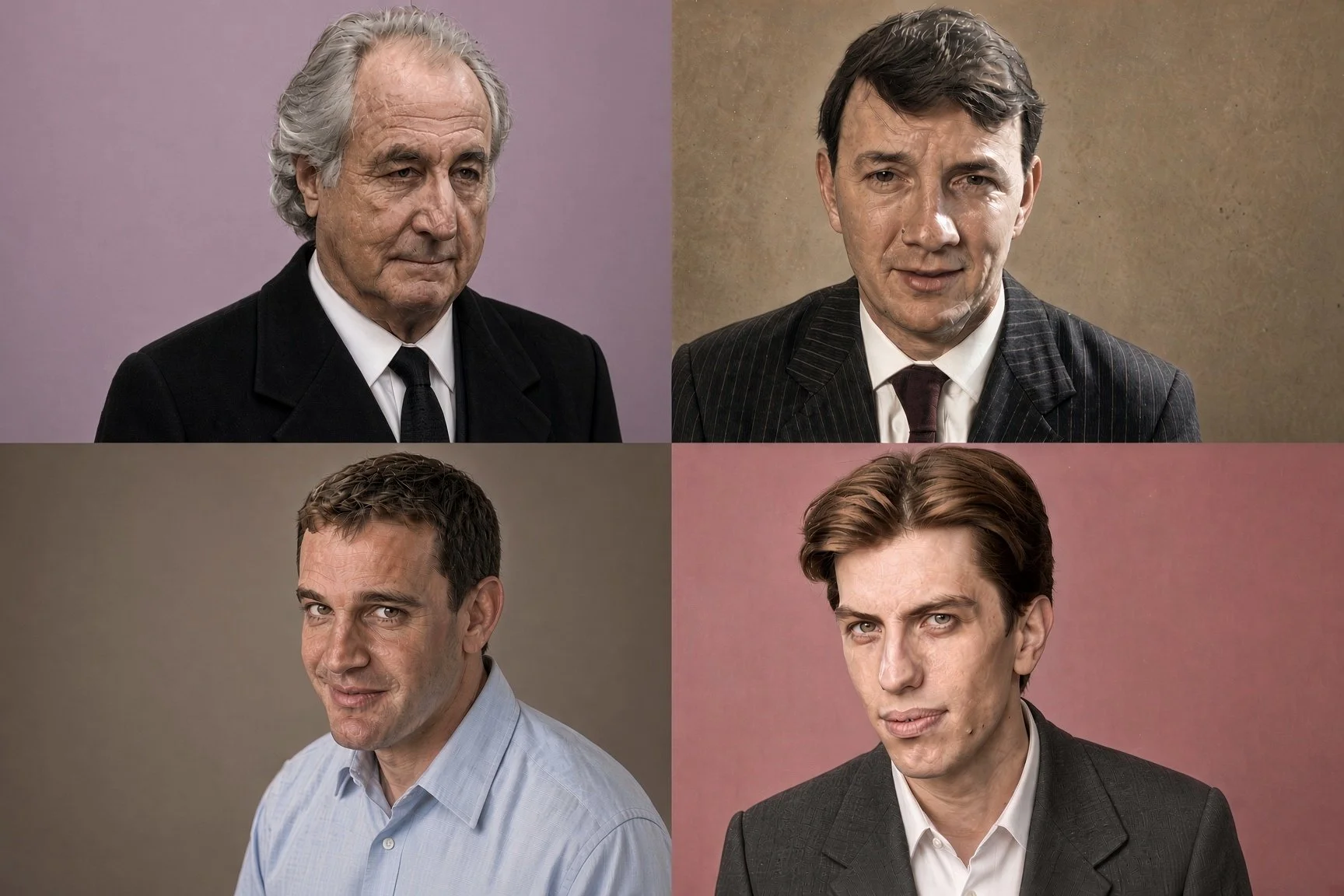
Left to Right: Bernie Madoff, John Meriwether, Brian Hunter, Leopold Aschenbrenner
Key Points
Hedge fund managers are sophisticated investors and traders, and yet, when it comes to the boring parts of operating their own business, they often fall short.
Concentration and leverage usually get the big headlines. But more common causes of fund failure are generally linked to operational issues like accurate reporting, sufficient team structure, and risk controls.
Looking at failed funds is only useful if it changes what you ask before you send capital. When reviewing, ask: can we verify them, do we actually need their strategy, and do we want to work with their people?
The Story People Prefer to Hear
Madoff Investment Securities, Long-Term Capital Management, Amaranth Advisors, Archegos Capital… and now this year, Situational Awareness joined the list. These are all investment fund names that became famous through failure.
When a hedge fund disappears, people like to tell the same old story. The manager made a bad bet. The market moved against them. The fund died. It is a simple story, and it is the one that is easiest to blast across the financial world.
We have been looking at some older studies and some new data that both say that the popular version of the story is incomplete. Plenty of funds lose money in catastrophic bets and still keep operating. Plenty more have a bad year, shrink in their aspirations, or return capital in an orderly fashion. The failures that actually wipe investors out, the ones that end up in court filings, with no real investor recovery, and become cautionary textbook passages, those usually involve something else.
When funds completely disappear, it is often simply because they could not be trusted on the basics of proper process and reporting. For example, what the fund actually owned, whether the reported numbers were real, or whether someone was trading capital in ways investors never agreed to. Those are not trading or investment thesis problems. They are operating problems. And they tend to become painfully evident much later in the final hours of distress.
Operational Issues
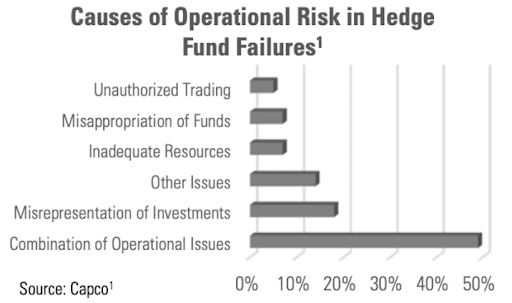
The classic 2003 Capital Markets Company, Ltd. (“Capco”) study suggests that about half of all hedge fund failures stem from internal breakdowns, poor middle and back-office management, or weak infrastructure.
Capco looked at roughly 100 documented failures over twenty years. Of course, they did not look at every single lesser-known fund. But even with that caveat, the split they found is telling: about 50% failed through operational risk alone, 38% investment risk alone, and the rest through business risk or a mix.
Inside that operational bucket, the usual suspects were misrepresentation of investments, misappropriation of investor funds, unauthorized trading, and inadequate resources. Inadequate resources is the unglamorous one. Those are the kinds of firms that just grew faster than their people did, faster than their systems or their risk assessments could keep up with.
We will discuss some historical examples of major funds that failed, why they did, and what can be learned from them. And yes, we will talk about what happened at the Situational Awareness Fund as well.
When Proper Reporting is the Problem
One example of bad reporting and the lack of basic disclosures causing hedge fund problems was detailed in a Reuters article that discussed the downfall of Wood River Capital Management. The fund failed to disclose to the SEC a conflict of interest with its investments: the firm invested 85% of its funds in a company that the hedge fund founder already had a stake in, and that portfolio company later crashed, wiping out the bulk of the Wood River Capital portfolio along with it.
Misrepresentation of Funds
The next reason on the list is misrepresentation of funds. The Ledger reported on one example by stating, ”Federal prosecutors sued the Bayou funds yesterday, saying the hedge fund company and securities firm run by Samuel Israel III directed a years-long fraud that attracted more than $300 million from investors.” “Bayou also created a bogus accounting firm, Richmond-Fairfield Associates, to certify Bayou's false financial statements,” the complaint stated. Apparently, that shell entity signed off on fabricated, steadily positive returns to hide the fact that the fund was bleeding money from its inception.
Concentration and leverage
And yes, another major reason many hedge funds fail is because of their risky bets. Of course, this is the reason that grabs most of the public attention, even if it's not the leading cause of failure. Liquidity concentration, multiple layers of leverage, and margin can be used to enhance profit, but maximizing a play through additional risk can work against the hedge fund in catastrophic ways.
The Story of Situational Awareness
If a hedge fund is overleveraged or makes a concentrated bet, it can go down rapidly, even threatening the wider market if its size is substantial. A recent example of concentrated risk that comes to mind is the Situational Awareness implosion, which experienced an 80% drawdown before restructuring.
The Situational Awareness Portfolio (fund), founded in July 2024 by AI enthusiasts and tech luminaries, quickly took off as it bet heavily on AI chips, AI infrastructure, and also bet against what it considered to be AI-damaged tech sectors. Its early success allowed it to attract big money, with Jane Street being one of the more prominent names involved.
With additional capital in play, it expanded its bets on AI. While most of the companies that made the fund’s portfolio list were publicly traded, it also had a stake in Anthropic, the creator of Claude AI. This was a stake that fund founder Leopold Aschenbrenner had acquired in the privately held AI giant. The performance numbers posted by the fund were staggering, as can be seen by its rise from August 7, 2025, to June 23, 2026, its highest measured day to that point.
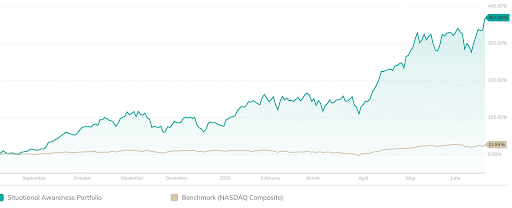
Measuring returns from August 7, 2025, Situational Awareness Portfolio was up about 367% through June 19, 2026. But those high returns did not last after a major tech squeeze that led to its demise and then a major restructuring effort to stave off total collapse.
The biggest reason Situational Awareness failed was that it didn't have a hedge against its thesis positions in case it proved wrong on effects or timing. As a hedge fund, it did not have a traditional market hedge. Technically, the fund was structured as a long-short equity fund, but its "shorts" were not designed to lower risk. Instead, they were part of a massive, one-way directional bet that Wall Street explicitly calls a "Texas Hedge." It worked as long as it was going their way. As soon as the market took a turn against their thesis, it fell like a house of cards.
The portfolio lacked genuine risk mitigation. While the long leg bet on rapid AI adoption, the short leg bet on the immediate displacement of legacy competitors. This structure created a highly correlated cross-trade rather than an effective hedge. It offered no protection against systemic delays or misjudged adoption curves, ultimately doubling the fund’s directional exposure to a single thematic assumption.
The second reason Situational Awareness had such a huge drawdown was it was overleveraged. The fund was trading at an estimated 4x to 5x leverage ratio (up to 400% leverage). This means for every $1 of actual investor capital, founder Leopold Aschenbrenner borrowed an additional $3 to $4 from prime brokers to supersize his bets. For a standard equity long-short fund, typical leverage usually hovers around 2x. Trading single-name tech stocks at 4x to 5x leverage is considered extraordinarily aggressive and obviously proved highly dangerous in this example.
The third reason was concentration of the bets. The overconfidence in the thesis caused the firm to violate fundamental rules of risk diversification. Founder Leopold Aschenbrenner channeled the vast majority of the fund's public capital into just a handful of massive, highly correlated bets.
According to the fund's Q2 2026 Form 13F regulatory filings, the concentration breakdown was staggering: More than half of the fund's entire public equity book was tied up in just two memory chip manufacturers:
SanDisk: The fund's largest position, valued at $5.7 billion.
Micron Technology: The second-largest position, valued at $5.6 billion.
Together, these two stocks alone accounted for over 56% of the fund’s total U.S. holdings right before the July collapse. When SanDisk plummeted 47% and Micron dropped 29% in a matter of weeks, over half the fund's leveraged equity base evaporated. Furthermore, the thesis itself was highly concentrated on one sector within tech.
Citadel’s Involvement
The unwinding of the Situational Awareness fund began on July 28, driven by a wave of market panic following Citadel's speculation of a hawkish Federal Reserve rate hike. As the broader markets turned downward, the highly leveraged AI trade experienced a violent correction. This directly exposed Situational Awareness, whose concentrated leveraged positions suffered rapid multiple compression.
To avoid total liquidation, the fund needed to offload billions in assets immediately. Capitalizing on their desperation and the lack of competing block liquidity, and echoing previous distressed buyouts, Citadel stepped in to absorb the risk but on its own terms. By purchasing the majority of the fund's book at a massive discount below market price, Citadel dictated a classic distressed-asset takeover, leaving the fund with no other viable path to survival. After the Citadel portfolio buyout, Situational Awareness has now rebounded moderately, it still exists, which is more than other failed funds can say.
At its peak, there were at least several signs that experienced investors might have potentially noticed and addressed:
Manager Experience: Generally, years or decades of outperformance are needed to separate luck from skill. A young fund and an emerging manager that has been successful for a little over two years qualifies more as a shooting star rather than as a beacon of light. Of course, every manager and fund was young once, but statistically few will survive long-term.
Lack of Liquidity: To deliver returns of this magnitude, not only do managers have to be right in their bets, but those bets must be supercharged by either adding substantial leverage to the strategy, or by using a majority of the available market liquidity, or often both. This concentrates risk in the portfolio, but also in the market.
Operational: The fund's back-office infrastructure, middle-office risk tracking, and operational headcount did not scale proportionally to its massive capital influx.
Valuation Mismatch: Mixing a massive, illiquid private venture asset with highly leveraged, daily-liquidity public equities creates an inherent valuation mismatch.
Inconsistent Reporting: The fund was using a network of top-tier prime brokers (including Goldman Sachs, BofA, and JPMorgan) but seemingly failed to report aggregate, cross-broker concentration risk accurately.
How These Findings Affect Our Behavior
Ultimately, at our own firm, we are trying to build better operational systems to address these pitfalls. What is the point of running autopsies and post-mortems on failed firms if it doesn’t inform our own internal behavior?
To better understand firm operations, execution, and thesis, and to prevent exposure to catastrophic blowups, we use a common-sense diligence system. The reader is more than welcome to adopt some of these as well where it makes sense in your own process. Our basic framework of initial and ongoing reviews looks like this:
Step 1. Mandate
Do they currently meet our mandate? When reviewing hedge funds, you need to have a firm idea about what you are looking for. These are the types of preliminary questions we ask to get an early feel for whether a firm is worth our time in additional conversations:
Are they more systematic or discretionary in their signal and execution?
Can they simply explain why they have a durable or dynamic edge?
Are they trading liquid strategies? If so, what is their AUM vs. their realistic capacity?
How long have they been successfully managing capital?
What is their legal and compliance structure?
What are their stated previous returns, net of fees, on a monthly and annual basis?
Do they likely meet our mandated risk controls on max drawdowns, Calmar Ratio, etc?
What is their track record like, and is the data available for further review?
Step 2. Verifications
Can everything be verified? After some of our basic questions on performance and strategy get answered, we want to see their live results; we want access to as much data as we can review. Here are the bare minimum things we want to use to review, in the actual order of our preference. We would like to meet their team and speak with current investors to get multiple views of what it might be like to work with them:
Who does what at the firm? - Speak with managing partners and some execution or technology team members to get a better idea.
What have investors experienced so far? - Speak with investors, both current and previous.
Why are they potentially durable? - Written Thesis explaining their trading process, why it works, and why it should keep working.
Proof of performance, in order of our preference:
Audited trading performance records
Fund admin performance reports
Direct API pulls for trading accounts
All Brokerage Statements for trading accounts
Proof of AUM, in order of our preference:
Audited Statements
PDF or screenshot of broker statements
Written client attestations
Step 3. Internal Fit
Before initial allocation, do we want to work with their system?
Just because a team and system verifiably fit with our objectives does not mean we will allocate; we still want to see how their team interacts with ours, and how their system might interact with our portfolio. We ask our internal team these types of questions:
Do their people fit with ours?
How will their strategy work within our portfolio?
What problem does it actually solve for us?
How correlated is their strategy to our existing strategies?
How correlated is it to their benchmarks and ours?
How does their strategy generally behave in falling markets?