
Private Credit Avalanche
Is “safe” private credit getting caught up in a major bubble?
Read Time: 8 Minutes

Key Points
Private credit was sold as safe yield. That story is breaking.
Many of the loans sit under software and AI growth that assumes expansion never slows.
What is the Problem?
Private credit was supposed to be the safe-haven bet outside public markets. Cash flow looked predictable. Institutions and smaller offices alike could pick their own yield, put it on the shelf, and not have to sit through public market volatility; it felt ideal and reliable.
That dream is changing quickly. Yields are on the rise, the Fed may have to hike rates, credit is becoming expensive and could cause a snowballing private credit effect that ripples across multiple industries.
Early Cracks are Forming
It's a $3.5 trillion problem, and very few are paying close attention to how big the cascade could be. Distracting headlines are filled with the AI boom, how AI is going to disrupt lives, and how everything will be made with the help of AI and how the world will be a better place once AI reaches its full, albeit elusive, potential.
As everyone else is distracted, some are noticing what is brewing beneath the surface. With the ongoing war and higher inflation, the Fed’s hands are tied and will have a hard time lowering interest rates. They may even have to hike rates.
The sector that gets hit hardest if that happens is the same one financing much of the AI buildout and also sitting under a lot of daily business and even some retirement account exposure: private credit.
The private credit market refers to a segment of the lending market where debt is provided by nonbank lenders to borrowers outside the public capital markets. Private credit debt instruments are customized loans negotiated directly between a lender and borrower rather than bonds issued in public markets or bank loans.
Private credit has grown about 14x since the 2008 financial crisis, when it was just a $245 billion industry. Tighter capital rules pushed banks away from certain corporate lending; low rates and yield hunger pulled capital from pensions, insurers, endowments, and increasingly retail investors into funds run by Apollo, Blackstone, Ares, Blue Owl, and others. Unlike public bonds or syndicated loans, private credit loans rarely trade.
Recently, in March of this year, BlackRock, a titan in asset management, capped withdrawals from its $26 billion flagship private credit fund (HLEND). The firm enforced quarterly caps after receiving over $1.2 billion in investor withdrawal requests.
Investors asked for 9% of their shares back in a single quarter, nearly double the 5% cap. BlackRock paid out 620 million in pro-rated shares and told the rest to wait to prevent asset fire sales. HPS leadership framed it as “preserving capital”.
This move highlights significant financial system stress and raises concerns about private lending practices within the broader shadow banking system. The music is currently slowing down. When stress hits, markdowns could arrive abruptly.
And then again in August, BlackRock’s TCP Capital sold about half its loan book to clean the fund up. That was $523 million of loans across 78 companies, sold in a deal with Pantheon. TCPC only received about $152 million in cash after the transactions.
Their Net Asset Value (NAV) fell about 10% in the fund. They had to do it. The fund was too levered, the stock was weak, and they could not keep sitting on marks nobody wanted to buy. After they cut the private credit risk, the stock went up. Investors preferred the smaller, cleaner book to the old numbers.
Some analyses note private credit forming a large share of certain insurer portfolios, raising the prospect that losses would hit retirement security rather than trigger classic bank run dynamics. Multiple layers of leverage can amplify the fallout.
The FSB and IMF have warned that rapid growth, fragile borrowers, stale valuations, and unclear interconnections create vulnerabilities that could become systemic in a severe downturn; the sector has never been stress-tested at today’s scale.
Let's take a deep dive into what has happened in the past 9 months in private credit markets.
Distress is Easily Hidden
In September of 2025, the First Brands Group holdings company filed for a Chapter 11 bankruptcy. It was a privately owned auto supplier. This company had $10 billion in debt, much of it off-balance-sheet.
Creditors said the company pledged the same invoices to more than one lender. When that broke, about $2.3 billion in receivables disappeared. Marathon Asset Management, UBS, Jefferies, and Millennium all got hit at once.
Last year, BlackRock paid around $ 12 billion to acquire HPS Investment Partners, one of the largest private credit providers in the world. Larry Fink was going to bring about private credit to the masses. BlackRock's 2030 growth strategy was built around this idea. Then just 8 months later, that's when their flagship fund hit the huge wall of redemptions described earlier.
In February of 2026 Blue Owl restricted withdrawals from retail-facing private credit funds. They sold $1.3 billion in loan assets across three funds to raise cash, Verdad Capital called it a canary in the coal mine.
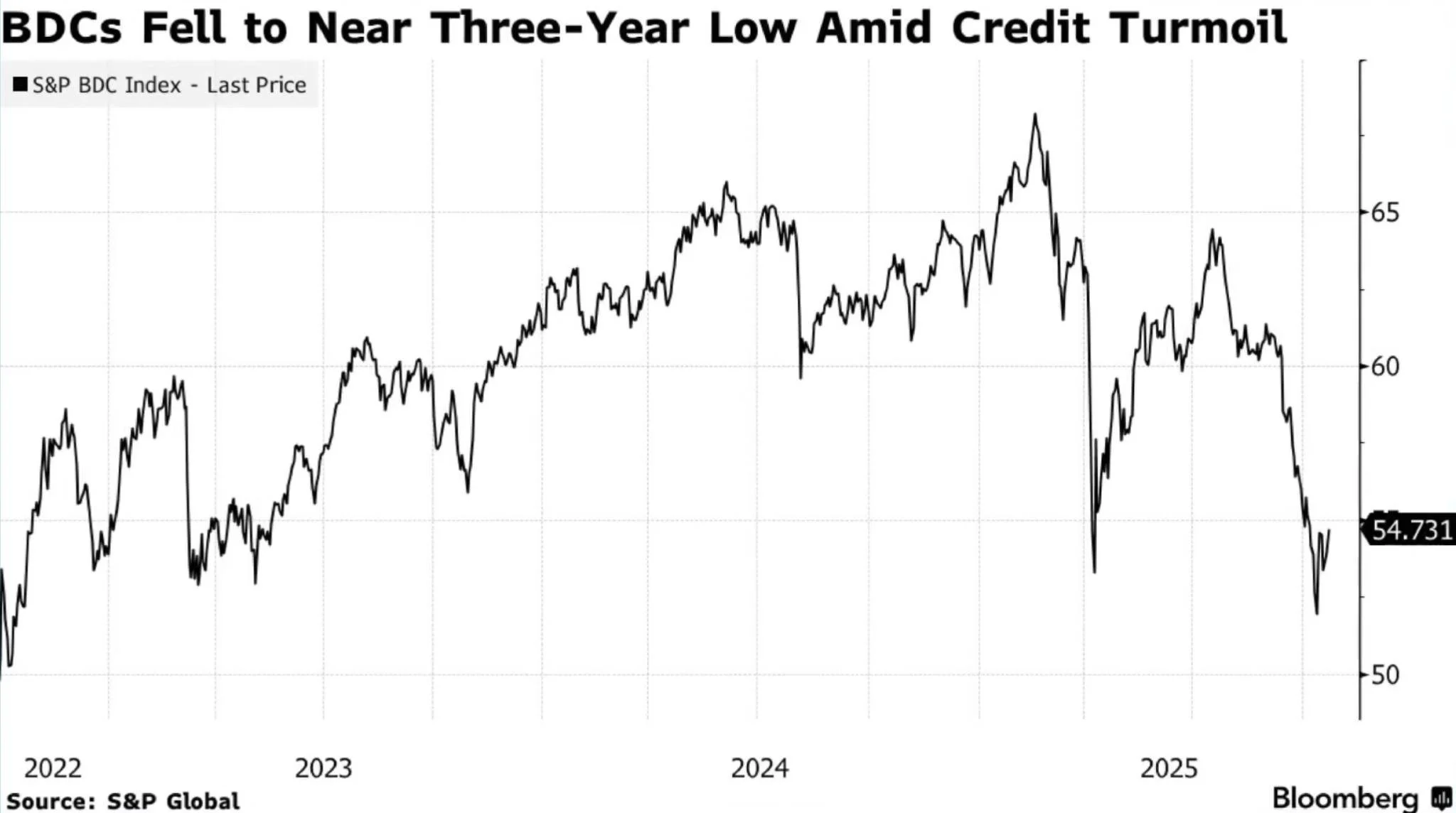
In short, meaning early warning signs of what is to come. The industry has become very good at hiding distress underneath creative restructuring but that doesn't make the distress go away.
Who is Exposed?
Now the question is who is most in danger when the music slows and when redemptions hit, it's partially the mom-and-pops who are chasing the small yield with their “safe investment”.
Retail now directly holds about 24% of private credit, through business development companies (BDCs), and the funds that promised they could get cash out when needed. Those are the people least equipped for a lockup.
Institutions still hold most of it, about 76%. But retail is also exposed a second time through pensions and insurers that bought the same loans. When the retail funds gate their investors, it hits the household first. When the institutions have to mark the book down, it hits retirement money as well.
But it gets much worse. Institutions capping investor redemptions is only part of the problem. The deeper issue is what the private capital was actually lent to.
Software and AI CapEx Problems
During the cheap-money Covid years, private equity went on a buying spree for software companies. They loved the recurring revenue, high margins, strong cash flow, especially around Software as a Service (SaaS) companies. Private credit funded those buyouts at scale.
Direct lenders were under 20% of large buyout financing before rates jumped. Then they took a much bigger share. Software became a huge slice of those books. Since 2021 it has been about 38% of jumbo private credit deals, versus about 18% in the broader market.
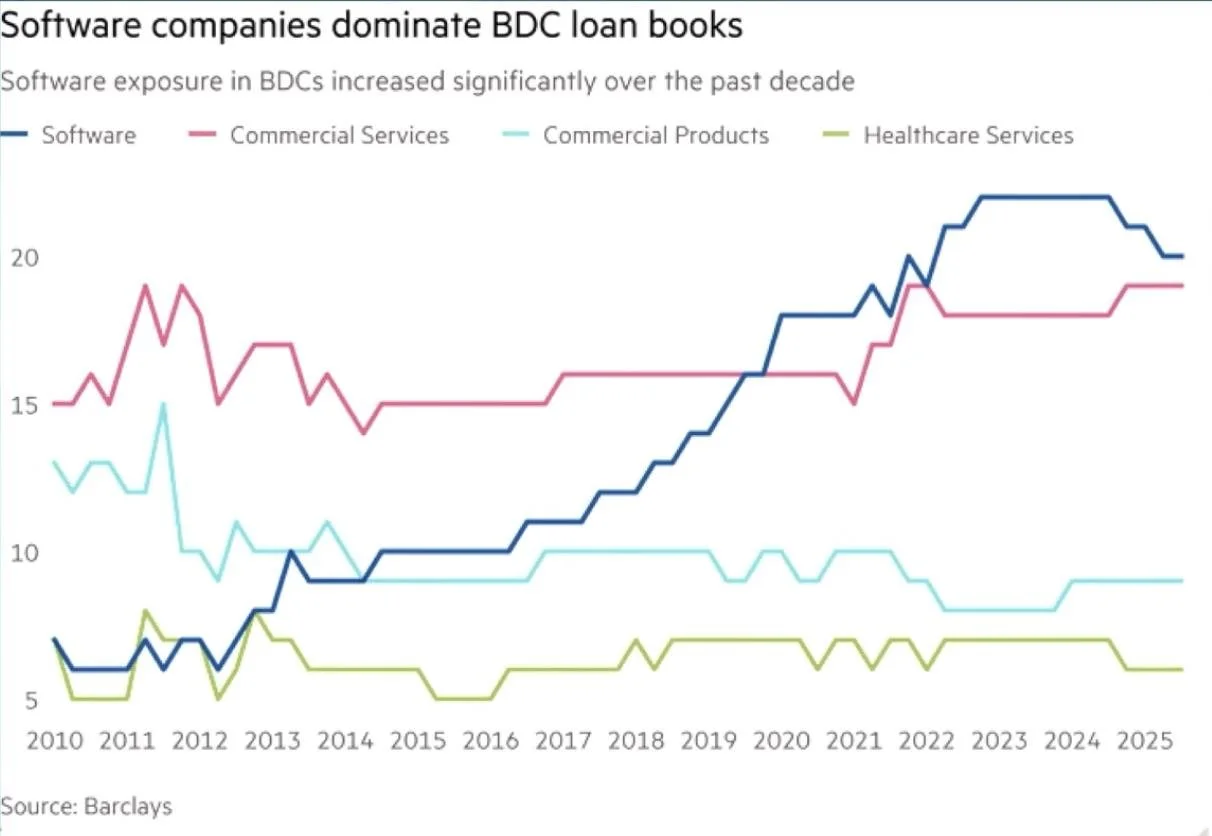
Private Credit is now about 2 times more concentrated in a single sector, which makes things worse. Tech has always been a volatile sector. One past example that comes to mind is the dot-com bubble. But it is far different than what is happening right now, as Institutions and private credit firms are highly concentrated in a sector that is outperforming everything else.
If we take the tech spend out, a lot of the recent growth disappears. Technology and software investment accounted for most of US GDP growth in the first half of 2025, and it has still been about half the story since then. Once this bubble is inflated to the point it stops growing, GDP growth will fall, which will push the whole US into a recession and could be far worse than 2008.
In 2008 everyone was concentrated in the housing market on the belief that house prices never really come down, but in today's world everyone is largely concentrated in tech. The S&P 500 is about 40% tech and tech companies are getting loans left and right on the expectations of future returns, which is already shifting.
Software loans were repackaged as BDC loans and those vehicles got sold to retail investors. The whole thing was based on an assumption that SaaS revenue is predictable and most likely never comes down either. But today AI is breaking that exact same assumption.
UBS has said that in a severe case credit default rates could hit 13-14% which is several times higher than the historical average, and timing couldn't be worse as most private credit loans have 5-7 years of maturity.
Back in 2020-2021, SaaS was the most profitable business model in the market and was given loans at unprecedented levels that are maturing soon. Back then the rates were low and it was easy to refinance. But now companies that borrowed when rates were near zero are having to deal with 8- 10%.
Software Companies are assets by design. Their code is the collateral, but with AI able to code complex solutions in days instead of months, that collateral is at risk, and that's what is getting reflected in SaaS stocks lately.
One prime example is the CRM giant Salesforce, which fell as much as 44% from its high. Now the question is whether this stays contained or leaks into everything else. Only time will tell.
And here’s the really messy part. The same AI that’s starting to break the software loans is also what private credit is feverishly chasing next with data centers, power production, and chips. If the whole AI story cools down, a lot of this credit is going to feel it at once.
Takeaways
1. Always understand the liquidity rules of what you are investing in.
2. When you invest in private credit, always find out what it’s being lent to. Private credit is only as good as the borrowers.
3. If you own a lot of tech and AI stocks right now, take a good, hard look at what the market prices are assuming about growth that never slows down. If the story changes, valuations could change quickly.